December 5, 2025
EU Thresholds from 2026: More Opportunities - but only for companies that can evaluate quickly
Raphael Mielke (Co-founder of Scelion)
Starting January 1, 2026, new EU thresholds for public contracts will come into effect. The amounts that require EU-wide tenders will be slightly adjusted. For public contracting authorities, this means EU-wide tenders will be necessary even for some lower volumes. For companies, it means increased competition for major contracts.
An Overview of the New Thresholds for 2026 - 2027
The following thresholds (net) will apply for EU-wide procurement procedures starting January 1, 2026:
Traditional Contracting Authorities (Directive 2014/24/EU)
Supply and service contracts for central authorities: 140,000 EUR
Supply and service contracts for other (sub-central) contracting authorities: 216,000 EUR
Construction contracts: 5,404,000 EUR
Social and other special services (Annex XIV): 750,000 EUR
Sectors Contracting Authorities (Directive 2014/25/EU - Water, Energy, Transport, Postal)
Supply, service contracts, and design contests: 432,000 EUR
Construction contracts: 5,404,000 EUR
Concessions (Directive 2014/23/EU)
Construction and service concessions: 5,404,000 EUR
Beyond these values, an EU-wide procedure is generally required. Contracts below these thresholds can be awarded according to national law, often with significantly simpler procedures.
Above or Below Threshold → Different Rules
Whether a contract is above or below the threshold is no trivial matter.
This affects, among other things:
which procurement regime applies (EU procurement law vs. national regulations)
how formal the procedure is
which qualification, reference, and turnover requirements must be met
how extensive the required documents and evidence are
In many cases, a company is formally not qualified - or the effort is disproportionate to the opportunity. The problem: This information is often hidden in long texts, participation conditions, and specifications.
The Reality Without Support
In practice, it often looks like this: A team downloads the documents, flips through dozens of pages of PDF, marks requirements, manually compares them with previous references, key figures, and certifications - and after an hour realizes: "We don't really fit the mold" or "The threshold and type of procedure make it unattractive for us".
By then, valuable resources are already tied up. Multiplied by many tenders per month, qualification quickly becomes a bottleneck.
How Scelion Eases the Qualification Process
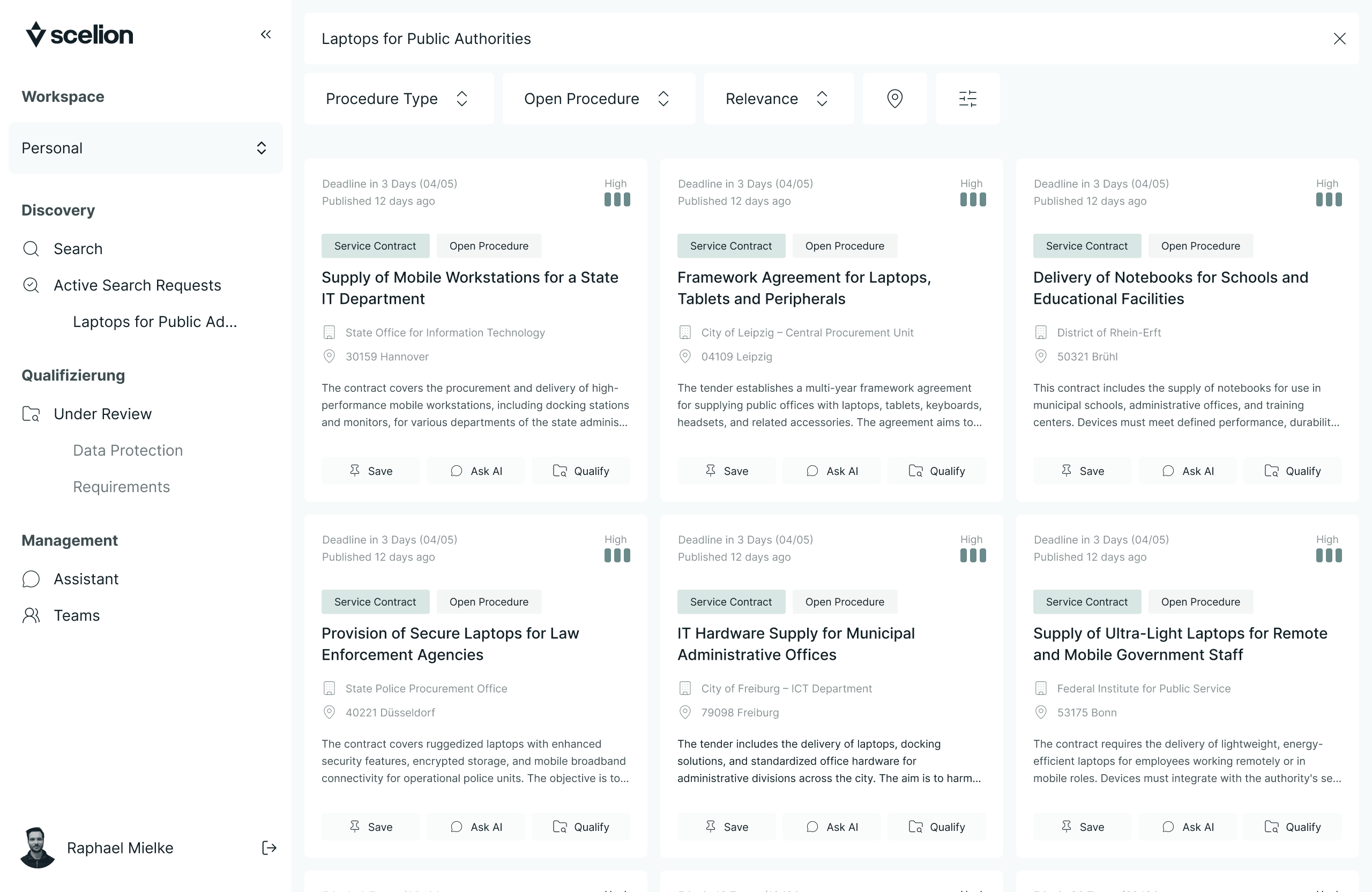
This is where Scelion comes in, transforming the "reading marathon" into a structured decision-making process in moments.
The platform:
automatically detects whether a procedure is above or below the EU threshold
uses AI to read announcements and tender documents and extract
key data (contract type, volume, duration, procedure type, deadlines)
identifies qualification, reference, and turnover requirements
matches this information with the stored company profile (industry focus, references, certifications, sizes and revenue classes)
The result is a quick assessment of whether a procedure is fundamentally suitable - including indications of which requirements are well covered and where risks lie.
More Focus on Suitable Tenders
When qualification no longer takes an hour per procedure, but only a few seconds, it transforms the entire sales approach in public markets:
Teams quickly sort out unsuitable tenders.
The newly available time is invested in truly attractive procedures.
Bids can be developed more directly and professionally.
With the new EU thresholds from 2026, the number of relevant tenders will grow. Companies that quickly identify which procedures truly match their profiles will have a clear advantage in this environment - and Scelion is built precisely for this purpose.
Source: Delegated Regulation (EU) 2025/2152, 2025/2151, 2025/2150